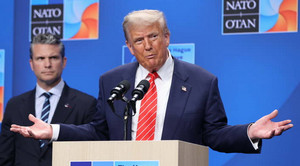
The Future of NATO: Challenges in the Face of New Global Threats
The war in the Middle East has brought to the forefront an important question regarding the future of the North Atlantic Treaty Organization.
The issue is not new; it stems from Donald Trump’s conceptual vision, as he has criticized the United States’ membership in NATO since his first presidential term. For example, in 2018, he harshly criticized the key Article 5 of the North Atlantic Treaty, questioning the USA’s obligation to participate in the defense of “a small country like Montenegro, located thousands of kilometers away.”
The issue, of course, is not the size of the country or its distance from the United States. The reasons lie in the principles embedded in Trump’s “America First” concept: a foreign and domestic policy that prioritizes the USA’s national interests over global commitments, alliances, or international agreements. The current White House leader’s vision is based on economic nationalism, strict border protection, and a reduction in American military involvement abroad, grounded in “principled realism”. These are the main reasons why the Alliance operating on the principles established in 1949 does not suit Donald Trump.
And although, in historical retrospect, the initiative to create a defense alliance of Western nations was Anglo-French, the North Atlantic Treaty was signed on April 4, 1949, by representatives of twelve states in Washington, D.C. NATO was founded with the support of the United States’ initiative and active participation in those processes, as well as due to the UN’s inability to ensure world peace at the time, when the USSR vetoed a significant number of the Organization’s Security Council resolutions. Thus, the USA became the “inspirer” and organizer of the North Atlantic Alliance and, for over seventy years, expanded the Organization under its “security umbrella”, particularly on the European continent.
The current occupant of the White House is breaking many traditional notions, mechanisms, and established global norms. Some of his statements and decisions seem to defy common sense. Now he has decided that the time has come to dismantle an international defense and security alliance founded on principles and structured in a way that no longer meets modern challenges. He recently made a sensational statement about the seriousness of the United States’ intention to potentially withdraw from NATO.
He reiterated this view to the British newspaper The Daily Telegraph, calling the Alliance without the USA a “paper tiger” and its European allies “cowards”. The reason, in his view, was “the unwillingness of other member countries to support American objectives in Iran”. Of course, this is not a reason, but an excuse – though, let’s face it, a rather convenient one.
As is well known, discussions on reforming the Alliance have intensified since 2018 [1]. Russia’s large-scale armed aggression against Ukraine, which began in 2022, and then the USA/ Israel war against Iran in 2026, have brought to the forefront issues of effectiveness, capability, and, by and large, the very point of NATO’s existence in its current form.
Currently, we can see reactions to D. Trump’s rhetoric from Mark Rutte, Emmanuel Macron [2], Friedrich Merz, and Keir Starmer. President of the Czech Republic Petr Pavel has clearly stated that “NATO was founded as a defensive alliance, whose primary mission is the collective defense of member states’ territories”. Citing Article 5 of the North Atlantic Treaty, he pointed out that “the United States has not been attacked, and Iran is not a member of the Alliance; therefore, the participation of other NATO member states in a war in Iran makes no sense and does not correspond to the principles upon which the Alliance was founded.”
At the same time, Prime Minister of Italy Giorgia Meloni, in an interview with the Financial Times, disagreed with the notion that there is a need to “choose between the USA and Europe”. She rejected such a “childish” choice, asserting that she understands a leader who “defends his national interests”. She condemned the “overly political” reaction of some European leaders to Donald Trump’s remarks, emphasized that his approach to defense would serve as an “incentive” for Europe, and confirmed that she would continue to respect her country’s “foremost ally”.
Also noteworthy is the position of the former US Special Envoy to Ukraine, retired Lieutenant General Keith Kellogg, who on April 2, 2026, stated on Fox News that there is a need to create military alliances as alternatives to NATO. “We need to rethink the defense structures we have, perhaps creating them with Japan and Australia, as well as with some of those European countries that are ready to go to war, such as a new, re-engaged Germany or Poland. Or even Ukraine, which has also proven itself to be a good ally,” he emphasized.
At the moment, it is difficult to say whether the USA will actually invoke Article 13 of the North Atlantic Treaty to withdraw from the Organization, but even in that case, the Alliance would have at least a year to reorganize [3]. The debate sparked within NATO by the White House chief’s statements is only just beginning. What conclusions can be drawn at this point?

Donald Trump’s statements can be viewed as pressure on Alliance member states, which, in turn, must urge their political leaders to take concrete action. This is how the system of interdependence works, even within the framework of strategic partnerships. The security threat “looming” over Alliance member states in Europe is forcing them to actively adapt. Indeed, if the USA were to withdraw from NATO, the North Atlantic Alliance would lose a significant portion of its military capabilities. In many areas, the USA maintains a balance with the capabilities of Canada and Europe and significantly outnumbers them in terms of aircraft and nuclear warheads (see infographic). This poses a real threat to the security of the Organization’s member states; they must act quickly to urgently build up their own defense capabilities. The dynamic processes unfolding in the world leave NATO no choice but to begin the transition toward creating new capabilities during the 2026–2027 period, as agreed upon at the meeting in June 2025.
And here, in fact, the question should be directed at the Organization itself: why, throughout the Organization’s history and during the 38 summits held to assess and determine the Alliance’s strategic priorities, was the pressing issue of NATO’s transformation in response to the challenges of the new security environment never properly addressed? A possible answer lies in the fact that this cumbersome and bureaucratic Organization felt comfortable under the American military and financial “umbrella”, fulfilling every whim of its transatlantic partner while neglecting its own security concerns. This conscious dependence on Washington has turned into a threat to NATO. Over the years of repelling military aggression from the Russian Federation, we have seen firsthand the Alliance’s defensive effectiveness – at the very least, as evidenced by Russian UAVs entering the territory of member states and the Alliance’s response being limited to expressions of “grave concern”.
Therefore, the Alliance must undergo a complete doctrinal and defense overhaul as soon as possible. It is not enough to simply build up defense production in the context of World War II-era challenges; rather, an updated Strategic Concept for countering modern threats must be urgently implemented.
There is currently no clear answer to the question of whether the United States will withdraw from NATO. But what is undeniable is that the Organization itself must act more swiftly and be prepared to defend itself. This means that, to ensure their own security, member states’ economies must shift to a wartime footing, reallocate their budgets in favor of the defense industry, introduce new rules and standards, restructure logistics and management systems, and undertake many other measures. Fragmentation or clustering of the Organization is also possible, as is the creation of military alliances alternative to NATO, in accordance with Keith Kellogg’s statements.
One doctrinal question requires clear legal regulation: can a single member of the Alliance independently launch a military attack on another country without the consent of the Organization’s member states? If so, what should be the decisions and actions of the other coalition partner states? The US/Israeli war in the Middle East has brought these issues to the forefront as well.
We are accustomed to viewing the world in simplistic terms. A superficial assessment of current events leads to the conclusion that Trump’s statements and actions weaken the Alliance and erode mutual trust. Furthermore, these actions can be seen as playing into the hands of Putin and other centers of influence in the Global South. But there is another “side to the coin”: such decisions spur the Organization toward reforms and accelerated modernization, which is desperately needed in today’s security environment.
The threat of the USA’s possible withdrawal from the Alliance may be a Trump’s pressure tactic aimed at boosting the defense capabilities of member states. The most painful blow to NATO could be the blocking of Alliance funding, the cessation of intelligence sharing, the failure to appoint an ambassador to NATO, and the withdrawal of US officers from NATO’s Strategic Operations Command in Mons (Belgium). Let’s not forget that there are about 100,000 US military servicemen in Europe, concentrated mainly in Germany, Italy, Poland, and the United Kingdom.
Therefore, such statements from Washington should be taken seriously. If Donald Trump “shuts down” these resources, the European part of NATO will lose its ability to conduct large-scale operations, thereby turning the Alliance into the “paper tiger” he speaks of. At the same time, this opens a “window of opportunity” for the Kremlin leader, whose goal is to divide the Alliance and regain influence on the continent. Ukraine, which remains entirely dependent on financial and military support from its Western partners, is also at the epicenter of this danger.
It is becoming clear that, for security reasons, European states will have to urgently find ways to replace American defense capabilities not only in specific key areas (strategic intelligence, logistics, etc.), but also in the spheres of command, defense technologies, and industrial capacity. A “European NATO” must become self-sufficient and independent in ensuring the continent’s security in the context of 21st -century warfare.
The Ukrainian Factor
As is well known, Ukraine has a strategic course toward Alliance membership enshrined in its Constitution, the status of an Enhanced Opportunity Partner (since 2020), and is a participant in NATO’s Enhanced Opportunity Partner (EOP) Program. The key instrument for implementing reforms in Ukraine with NATO’s support is the Annual National Program of Ukraine-NATO Cooperation (ANP). The Joint Ukraine-NATO Center for Analysis, Training, and Education (JATEC), NATO’s representative office in Ukraine, is actively operating in Kyiv.
The question now arises: what kind of NATO are we striving for, and what standards must we meet? There is likely some truth in Keith Kellogg’s words: Ukraine, which has “proved itself to be a good ally”, should be one of the leaders in the restructuring of NATO’s defense structures, alongside European countries that are “ready to go to war”.
The Telegraph correctly points out that Ukraine itself is becoming a guarantor of security for Alliance countries, which now particularly need Ukrainian experience and skills to be ready to repel aggression in modern warfare involving drones and robotic systems. Indeed, our country has a battle-hardened and combat-trained Army, modern defense technologies, and innovations – that is, what can significantly strengthen NATO and enhance its capabilities for future confrontations. We have, in Trump’s terminology, “trump cards”.
Perhaps it is for the best that the issue of Ukraine’s immediate membership is not yet being considered. For now, another priority issue must be resolved – the transformation of the Alliance itself, the introduction of a new architecture, doctrinal rules, and other standards.
This dilemma has a purely political solution. A “window of opportunity” is now opening for our country to become one of the leaders in shaping a “European cluster NATO” and to gain status and influence as a key player within it.
The next NATO summit, scheduled for Ankara this summer, should provide answers to many complex questions.
Yurii Romaniuk,
expert on political and security issues,
Candidate of Pedagogical Sciences
Volodymyr Palyvoda,
expert in international relations
Notes:
[1] Discussions on NATO reform intensified at the Brussels summit due to a convergence of several critical factors that called into question the Alliance’s former model of operation.
The administration of US President Donald Trump began openly and forcefully demanding that European allies increase defense spending to 2% of GDP. This sparked a debate on the need for internal reform of NATO’s funding mechanisms and member obligations.
At the 2018 summit, an initiative was put forward to enhance mobility and response speed (the so-called “4×30” readiness strategy): the Alliance was to be able to deploy 30 mechanized battalions, 30 air squadrons, and 30 combat ships within 30 days.
It was during that period that NATO officially recognized cyberspace as a separate operational domain (alongside land, sea, and air). It was decided to establish a Cyber Operations Center and support teams to counter hybrid attacks, which required structural changes to the command system.After
2014, the Alliance gradually shifted from “out-of-area” peacekeeping missions (such as in Afghanistan) back to collective defense tasks in Europe. In 2018, this process required a large-scale reform of the military command structure.
The year 2018 marked a significant milestone when NATO clearly articulated its requirements for Ukraine regarding the transformation of its Armed Forces to Alliance standards and the establishment of civilian control over the Ministry of Defense.
These events laid the foundation for the subsequent “NATO 2030” strategy, which formally marked the transition to a new phase of Alliance reform amid global competition and new technological challenges.
[2] On April 3, 2026, during a visit to the Republic of Korea, President of France Emmanuel Macron called for the creation of a “coalition of the independent”, which would bring together a number of countries to counter the United States’ unpredictability and China’s hegemony.
[3] Article 13 of the North Atlantic Treaty states: “Twenty years after the entry into force of this Treaty, any Party may terminate its participation in the Treaty one year after the deposit of a notice of termination with the Government of the United States of America, which shall inform the governments of the other Parties of depositing of each notice of termination”. This presents an interesting situation. If Donald Trump follows through on his threat to withdraw from NATO, the US government will have to inform itself of this decision.